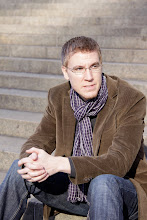
During our brief visit to NYC I had to the remarkable opportunity to meet with the artist Barton Liddes Benes. I came to know his work through the UND art department and his connection to the North Dakota Museum of Art. While his work is somewhat transitioning, Barton is widely known celebrity relic pieces. Using traditional religious relic motifs, Benes transforms them with our cultures religious-like worship of celebrity. Bits of celebrity trash and other cultural oddities make their way to Barton through a vast network of friends and into his work. The diversity of relics is astounding from Frank Sinatra's fingernail to Madonna's panties, these little bits of ephemera gain importance via their provenance.
Saturday, June 18, 2011
NYC and Barton Benes
During our brief visit to NYC I had to the remarkable opportunity to meet with the artist Barton Liddes Benes. I came to know his work through the UND art department and his connection to the North Dakota Museum of Art. While his work is somewhat transitioning, Barton is widely known celebrity relic pieces. Using traditional religious relic motifs, Benes transforms them with our cultures religious-like worship of celebrity. Bits of celebrity trash and other cultural oddities make their way to Barton through a vast network of friends and into his work. The diversity of relics is astounding from Frank Sinatra's fingernail to Madonna's panties, these little bits of ephemera gain importance via their provenance.
Thursday, April 28, 2011
The Archival Turn...reflections on closing out the MFA
Monday, January 31, 2011
MFA Exhibit


Friday, January 28, 2011
Shows
Thursday, January 27, 2011
My Studio
Wednesday, October 6, 2010
Keepin' at it...
Friday, September 24, 2010
Valley City State University Show
UND Graduate Students, Meghan Duda, Ryan Stander, Patrick Awotwe, and Jessica Christy will be on campus Friday, September 24 working with the VCSU Art Students. A panel discussion is scheduled in McCarthy 356 at 2:00 pm and a reception for the artists will be held in the VCSU Art Gallery 4:00 - 5:30 pm. The VCSU community and the public are welcome to attend.
Five Graduate Students from the University of North Dakota’s Master of Fine Arts program were invited to submit work for the exhibition that sets the stage for the artists' visit. The exhibition includes weavings from Patrick Awotwe; altered photographs from Meghan Duda; monoprints / monotypes from Anna Jacobson; lithographs, Ziatypes, and Cyanotypes from Ryan Stander; mixed media lithographs from Jessica Christy.
The Exhibition runs through October 1.
In his weaving and jewelry making Patrick Awotwe creates designs using traditional symbols that reference compositions from his African culture. Mr. Awotwe enrolled in graduate school in metalsmithing and jewelry and found a second creative voice in fibers. His homeland, Ghana, is noted for unique traditional weaving called kinte but his first fiber-works were created at UND. He describes the weaving of his daughter: "The Sunrise is a damask wall hanging that was inspired by Nhyira, my daughter. The bottom part shows a silhouette of her picture with fewer details and the top shows her full portrait. Traditional Ghanaian symbols “Gye Nyame” and “Afe “were used to give it an African identity. Nhyira literally means Blessing and the Sunrise is to describe her.”
Meghan Duda is fascinated with two things, architecture and photography. She has a professional degree in architecture from Virginia Tech and teaches an architectural photography seminar in the Department of Architecture and Landscape Architecture at North Dakota State University. Ms. Duda states, “My selected photographs are a study of cutting.” She frames her photographs around elements that can be removed thus creating negative space. Meghan has exhibited through out the Midwest and Virginia. She also has been published and received a finalist recognition twice in competitions presented by Photography's Forum Magazine.
The family farm lifestyle and the fundamentals of organic farming have been ingrained in Anna Jacobson inner self and thought process and thus is the basis of her work. Nature’s cycles and the North Dakota landscape found their voices in the color, texture, and process of her work. Coming from the flat plains of rural North Dakota, Anna learned the value of simple beauty. Her work is not filled with complex details or bright commercial colors, but rich, full earthtone colors and textured details of the great American Midwest. Anna received her BA in studio arts with an empasis printmaking from Concordia College in Morehead, MN.
Ryan Stander's interests in theology and art are rooted in ideas of place/space, memory and identity formation. Mr. Stander has a MA in Theology from Sioux Falls Seminary and a BA in Art from Northwestern College. His work included in the exhibition comes from two bodies of work. The Religion as a Chain of Memory Series draws upon his theological research into place and memory. His Ziatype and Cyanotype Icon / Altars “draw upon the interplay of memory, identity and the photographic object itself, while playing with the traditional forms of Christian iconography and devotional altars."
Jessica Christy’s mixed media lithographs are a response to mass media, contemporary art history, and family heritage. Technically her work examines not only traditional printmaking but also the territory beyond the practiced techniques. Her work has been exhibited through out the Midwest, on the west coast and in London winning numerous awards. She works with the master press at UND, as both an assistant to the master printer and as a master printer, printing lithograph and intaglio editions for various well-known artists. Ms. Christy teaches drawing, printmaking, and design at UND. Jessica is a Valley City State University alumni who graduated with a BS in Art.
Wednesday, September 15, 2010
Fall Beginnings
.jpg)
.jpg)
+web.jpg)
Somehow it is already the 4th week of classes? Where did this past month go? I have made great progress on my print for the semester. So rather than waiting until the end of the semester I thought I would put up a few now.
This semester's focus is on mapping. Toward the end of the summer I started playing with a few cultural maps. See them here. I am taking a similar approach to my current series as I did for the fly-over states print by hand tracing the map and using a separate plate for text formatted in Photoshop.
Thursday, August 26, 2010
Fall Semester 2010
Thursday, August 12, 2010
Summer Work VI
Another batch of lithos. This group is a random collection however...no unifying theme or direction. These first 2 prints are variations of each other and the one table top photo icon from my earlier postings. Summer Work V
This series continues the line of thought from the Religion as a Chain of Memory series in an alternative direction. There are 3 pieces in this series, but it looks like I forgot to photograph one. The prints contain an embossing of the state/province, 4 color separation portraits, local maps, and a regional landscape. The images are then chine-colle'd onto BFK. They are intended to be folded like an accordian (but i have not gotten to that yet)..jpg)
.jpg)
Summer Work IV
One of my continuing experiments has been with light and translucence of materials. My original hope had been to have these back lit with a light box of sort but the work and cost of producing that many light boxes quickly shut that door. I continued on with printing on various Japanese papers measuring about 24x39 which I then covered in wax to increase its translucence. This first is a Van Dyke on Mullberry which ripped horribly but was salvaged with cheesecloth melted into the wax. It produces a unique scarred look. The next few images are cyanotype images which normally have an electric blue color. These were toned to produce a more subdued eggplant hue. There is also one detail shot of a preliminary means of display. The intent is to have the image floating 4-6 inches from the wall..jpg)
.jpg)
.jpg)
Summer Work III
This series offers a twist to the previous postings. Maintaining the form and materials I made the iconographic dimension more explicit. I also began to experiment with the Ziatype process. The transitional piece uses a vintage photo of my father writing home during his 2 years stationed in Germany in the 50's. The small cyanotype is of an old home. The next image is of my father-in-law and the third, my brother-in-law. I shot these images this summer on our trip home to SK. These last two, and likely the third in a less literal way, are about place and the dialectic between humanity and the land..jpg)
Summer Work II
Another set within this series on panels deals with lost vernacular photos as objects and the severed memories associated with the photos themselves. This series has a tentative artist statement associated written below.
Somewhere hanging delicately between subjectivity and objectivity, memory functions. More than simple recall or a mental rolodex, memory is constituent of our very being. It informs. It orients. It is the deep well of our imagination. It can be shared and it is in perpetual reform. Within this delicate and mysterious dance, photography’s process and product enter as curious partners of memory’s fact and fiction, accuracy and distortion.
The photographic object spins out a silvery thread linking a past moment to the ongoing present. Our awareness of such is what Barthes’ called startling prick of the punctum, that historical moment of the shutter snapping open and closed allowing light to pour in and write its lingering image. That moment may persist for viewers today if they are able to wade through the flood of images that daily dull our senses, they may arrive at the alchemy of the photographic object itself.
This body of work draws upon the interplay of memory, identity and the photographic object itself, while playing with traditional forms of Christian iconography and devotional altars. By re-presenting lost vernacular photographs through such wooden panels, it intends to impart a loose religious reading to both the lost photographic object and its referent. Heightening this religious sense are the photographic processes themselves. By utilizing hybrid or alternative photographic processes, it creates a curious sense of age and sentimentality. Coupling these paneled images with smaller cutout images continues my interest in the composite which encourages the viewer elucidate the connection among the cluster of images.
.jpg)
.jpg)
Summer Work
.jpg)
.jpg)
.jpg)
.jpg)
Monday, May 24, 2010
Its PKAP season again...
While I feel completely spoiled for having gotten to go to Cyprus last year, and know that this is a very important summer for my MFA program here, I cannot help but to be a little sad at not going this year. While this season is not the same as last year (museum work vs. field work...from what I understand), I will miss the the quaintness of Larnaca, the historic streets, the bustling beaches, the Petrou Brothers apartments, Kalifatzia's haloumi sandwiches, Shark jokes, the community of the team, and of course the long hours of work in the sun.
Friday, May 14, 2010
Spring Semester Van Dyke Prints
One of the things I had hoped to do during my degree at UND was to learn some of the alternative photo processes. For those who may not know, these are some of the very first experimental processes that have hung around in the fine art world. Many of them are actually making a comeback in reaction to the precision of the digital revolution. For the final I made a small suite of 15 images that I had shot in Cyprus during the PKAP residency. I was enamored and overtaken with nostalgia and old world romance by the historical doors, architecture and quaint streets. I've attempted to print these through solar plate and digitally but was just unhappy with both. While the images may look great, it takes the right process to bring them out. The images are well suited for this process to create that nostalgic feel. Many, somewhat uncharacteristically, capture an amazing amount of detail in a range of warm brown tones. I will post the remainder of the suite tomorrow. 


Wednesday, March 17, 2010
Conference Schedules
This spring has already proven to be a hectic one with 2 conferences out of the way, Ive got 2 more to go. In just over 3 weeks I present at the Upper Midwest Region of the American Academy of Religion. This meeting, as every year, meets at Luther Seminary in St. Paul. This is my 3rd paper at this conference, which tends to be a collegial and fun affair. I am also excited about UND's presence at the conference. Patrick Luber, one of my committee members is presenting his research on the Viewmaster right after my paper (which ironically is in part wrestling with his wife Jennifer Nelson's artwork). But there are a few others from the religion department that are either presenting or chairing a session.
I will also be presenting at College Theology Society annual meetings this year. We will be traveling to the University of Portland for the conference which runs June 3-6th. You can see the conference details here and the presentation schedule here. Our theme of Religion, Economics, and Culture in Conflict and Conversation should be an interesting one.
Monday, March 15, 2010
Dan Attoe Visiting Artist


Two weeks ago (yes I am behind in my posting) Dan Attoe visited UND as part of the Myers Foundations funded Visiting Artist Series. Dan's visit stood out as one of the more significant for us as students. His generosity of time, energy, and encouragement were remarkable for us all. I was thankful for the connection to the printmakers so I got to spend a little more time with Dan as we printed 2 prints for him (a larger 11x22 and a smaller 10x10) for Sundog Press.
Tuesday, March 2, 2010
Red River Valley History Conference

This week Friday I will presenting some of my research on the New Topographics at the Red River Valley History Conference. At the encouragement of Bill Caraher I decided to submit an abstract for the conference. It was accepted and further filled my already over full plate. Oh well, it really has taken only a few days to merge the research into an acceptable format for the conference.
The paper proceeds with a brief overview of the New Topographic photographers and their work. It then transitions to set the group within an art, and particularly photo historical context. It then turns to the social science of Human Geography to explore the disciplines simultaneous emergence and focus on topics of place/space. Within that group of scholars I mention the work of Edward Relph to explore ideas of placelessness that may function as a subtext embedded within the work of the New Topographics. I then turn to several contemporary photographers to explore how these shared tendencies have continued on. All this within 20 minutes.
The highlight of the conference is the keynote address given by Dr. Robin Jensen on "Living Water: Rituals, Spaces, and Images of Early Christian Baptism."
Check out the conference schedule here...or here.
.jpg)
.jpg)
.jpg)
.jpg)
.jpg)